A clean heartbeat reading, from the upper arm
Patch reads your pulse with light, from the inner upper arm. A clean reading comes down to where the parts sit, how far apart they are, and which light we let reach the sensor.
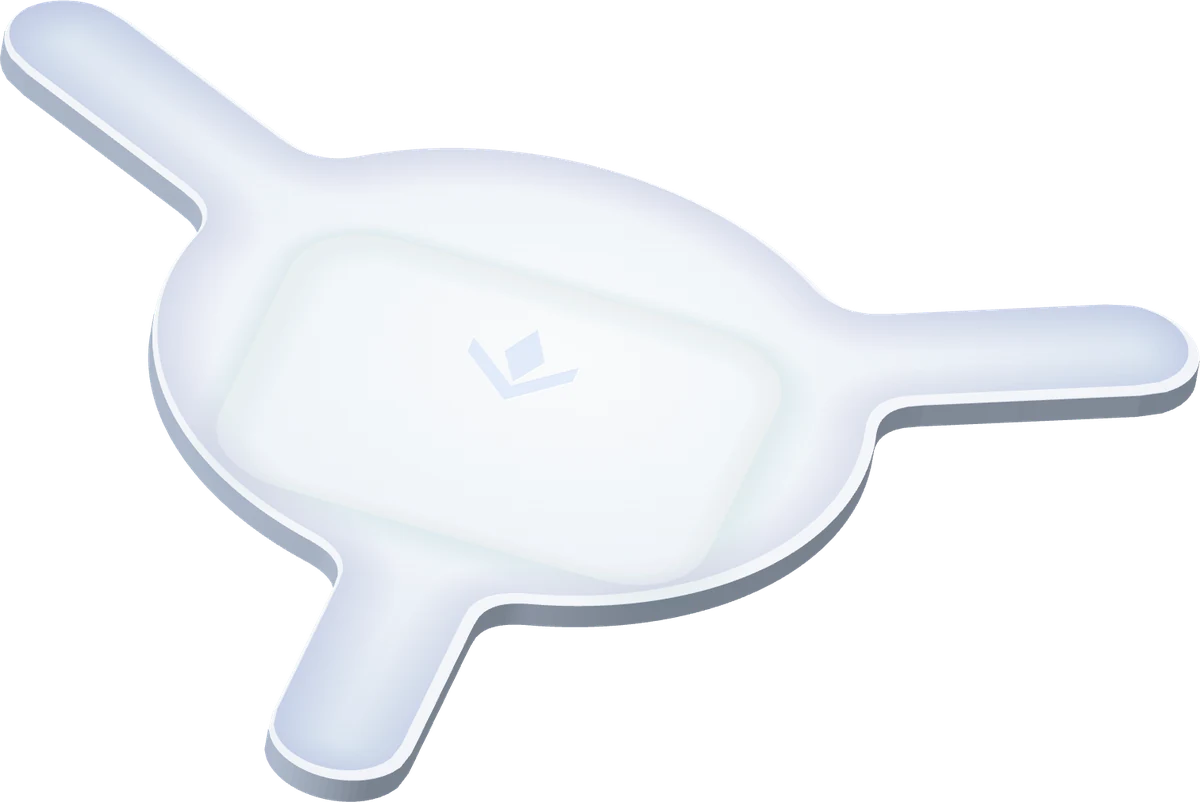
Patch reads a heartbeat by shining light into the skin and watching how much of it comes back. With every beat, the amount of blood in the small vessels under the skin rises and falls, and so does the amount of light the skin absorbs. What the sensor sees is a small ripple riding on a large, steady level. The whole job of the optical design is to make that ripple as big and as clean as it can be.
Patch is worn on the inner upper arm, and the optics are designed around that spot. The spot matters, but it doesn’t do the work on its own. The work is done by a few decisions on the board.
Where the parts sit
The LEDs and the light sensor sit together on the skin side of the patch, facing the skin, in the part of the patch that holds flattest against the arm. The reading depends on steady contact. If the optics lift away from the skin even slightly, the light takes a different path, and the ripple changes for reasons that have nothing to do with the heart. So the optics don’t go wherever there happens to be room. They get the best spot, and everything else on the board is arranged around them.
Why the spacing matters
The distance between an LED and the sensor is one of the most important dimensions on the board, and the right answer isn’t “as close as possible”. Light that enters the skin scatters in every direction, and the sensor can only catch the fraction that happens to scatter back out where it sits. The farther the sensor is from the LED, the deeper, on average, that light has traveled before it returns, and the more of the pulsing vessels it has passed through on the way.
Put them too close together and the sensor mostly sees light that skimmed the surface: bright, but with very little pulse in it. Put them too far apart and the light that returns has gone deeper and carries more of the beat, but there is far less of it, so the reading turns weak and noisy. In between there is a spacing where the ripple is largest compared with the noise, and that is the one we design for. The LEDs and the sensor aren’t just near each other; they are a set distance apart, on purpose.
Blocking the shortcut
The enemy of this reading isn’t darkness. It is light that reaches the sensor without going through the skin. An LED and a sensor a short distance apart on the same board have plenty of shortcuts between them: across the surface of the board, through any gap between the patch and the skin, or through whatever sits between the two.
Light that takes one of those routes arrives at a steady, bright level with no heartbeat in it at all. It doesn’t so much add noise as bury the signal. The sensor has a limited range, and if a leak uses up most of that range there is very little left for the ripple we care about. So the shortcut has to be closed physically: an opaque barrier between the LEDs and the sensor, so that the only way for light to get from one to the other is down into the skin and back out. Getting this right is as much a mechanical problem as an electrical one.
Why three colors
Patch uses three colors of light rather than one. Each color behaves differently in skin: some are absorbed strongly near the surface, others travel deeper before they scatter back. So the three readings are not three copies of the same thing. They share the heartbeat, and they differ in almost everything else: how deep they looked, how much the surface of the skin affected them, how much a change in contact or a little light from the room moved them.
Watching the same beat through three colors lets us separate what the readings agree on, which is the pulse, from what they don’t, which is mostly interference. It also gives us a choice. Skin and placement vary from person to person, and a color that gives a clean ripple on one arm may be weaker on another. Three colors give us room to pick the best one, or to combine them.